Multimedia Design - History and Context

Friday, September 22, 2006

Peter Lunenfeld - The myth of interactive cinema

What is the myth of interactive cinema? Why is the promise of interactive cinema so enticing? How can multimedia design further develop the potential to achieve more interactive environments?

interactive sculpture
Waves by Kumiko Kushiyama. Interactive sculpture - touch-screen display, which then shows an image of water moving in reaction to the viewer's touch. Retrieved from http://silicon-valley.siggraph.org/MeetingNotes/ArtGallery2003/waves.jpg

The myth of interactive cinema is that there could be a non-linear narrative that was chosen by the viewer of the film. The promise of interactive cinema is exciting because the viewer would be in control of their own cinema experiences rather than just watching a narrative being told. It is a myth because when you try to make non-linear narratives, that the viewer has control over, it is never possible, because all choices have to have been pre-planned and pre-filmed and there isn’t real choice and creativity on the part of the viewer, but just limited choices that have been created to choose from.

Multimedia design can further develop the potential to achieve more interactive environments by creating hyper-contexts that allow real choice and creativity and involvement by viewers. Examples of how multimedia can design more interactive environments are found in art that distil narrative to make the viewer/listener participate in constructing the narrative and making meaning in the work. Another example is in constructing a larger narrative, with many simultaneous narratives that therefore allow the viewer to be part of the experience, and not to fully be able to see all the possibilities and to have to make choices about what to view.

Thursday, September 14, 2006

Dorothy Kidd – Indymedia.org : a new creative commons.

Importance of alternative news sources. How successful are independent news sources such as indymedia.org? How can multimedia platforms truly provide an effective alternative to mainstream media?

alternative media
retrieved from http://www.jmk.su.se/global03/project/mediaday/Images/alternative.jpg

Independent news sources are very successful in presenting alternative views and broad discussion of issues from different perspectives. When mainstream media seems to present similar points of view, independent media are successful in hearing voices of activists, minorities, and opinions that need a voice but are not represented in mainstream media. Alternative media sources are also successful in being able to criticise and question power structures; which would be impossible for mainstream media sources that are owned and run by the powerful people who may need to be questioned or criticised.

Multimedia platforms have provided an effective alternative to mainstream media by enabling people themselves to “be the media” and share their views and discussions. Digital technologies, multimedia platforms, open-source and volunteer-run independent media can be an effective alternative, because they are decentralised and have the ability at little cost to offer alternative views and alternative presentations. Because digital technologies and access to digital image creating and editing equipment is much more available, sharing of alternative news sources is able to have a much larger number of contributors. Potentially anyone can contribute and use the alternative medias. They are a new creative commons that is run by the people for the people, independent and alternative.

Saturday, September 02, 2006

Sounds like techno

What roles do experimentation and deliberate misuse of technologies play in creative practice? How would you apply this to your own multimedia design process?


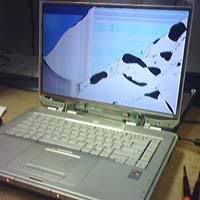
broken computer
retrieved from - http://geeseven.com/blog/wp-photos/20060622-203635-1.jpeg

“Play” is an important part of creative practice because it involves combining things in unexpected and unconventional ways to discover new solutions. Without experimentation, the solutions I come up with for multimedia design problems would be the most obvious solutions, but not necessarily the best. By experimenting, deliberately misusing technologies and playing, often creativity is inspired, and new solutions and things are discovered. If I didn’t try new things, experiment with how technology could be used rather than how it “should” be used, I would be a lot less creative, a lot more obvious and a lot more dull.

I incorporate experimentation into my multimedia design process by pushing past the obvious solutions I first think of, by trying to keep thinking and playing, even when I think I know what I could do. I experiment with combining things, I try to define the problem, and experiment with how I want to solve it. I try not to be limited by how technologies are supposed to be used, or how things are meant to be done.